
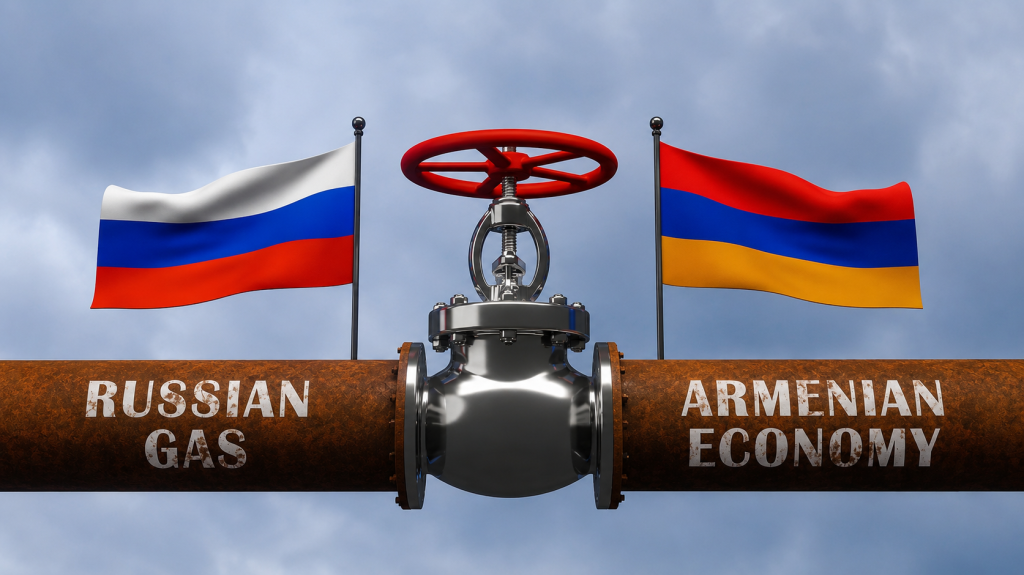
At the meeting between Russian President Vladimir Putin and Armenian Prime Minister Nikol Pashinyan in Moscow on 1 April 2026, the Russian President while discussing Armenia’s economic dependence on Russia hinted that the price of the natural gas supplied to Armenia could be revised and brought in line with the market level. Then on 27 May, a few days before Armenia’s parliamentary elections, Russian Foreign Ministry spokesperson Maria Zakharova announced that the Russian Embassy had passed a letter from the Russian Minister of Energy to the Armenian authorities through diplomatic channels. The letter warned that Russia might revise the gas supply agreement if Armenia continued its EU accession process.
Modern political science uses the term “weaponization” to describe the phenomenon where one country uses non-weapon elements against another to advance its political interests. Russia’s manipulation of natural gas prices is an example of weaponization, with the threat of an “explosion” hanging over our economy.
In this article we aim to describe how this vulnerability arose, how much Armenia gains from the preferential gas price and what alternatives for gas supply our country has.
How Armenia became so vulnerable to Russian gas
On 2 December 2013 Armenia and Russia signed two “gas” agreements.
According to the first agreement, the Russian “Gazprom” acquired the last 20% share of the Armenian government in the “Hayrusgasard” company through a direct sale, without the approvals and permits required by the RA legislation, becoming the sole owner of the entire gas distribution network of Armenia. In addition, according to the agreement, the Armenian side committed to buy natural gas exclusively from “Gazprom” until 2043.
The second agreement established the pricing mechanism for Russian natural gas supplied to Armenia. From 1 January 2014 the border price of gas was to be determined through an indexation mechanism. The index has two components: 65% reflects the change in the gas price in Russia’s Orenburg region and 35% reflects inflation.
As a result, Armenia became completely dependent on Russian gas supply. By design, however, the Russian side lost the ability to revise the price arbitrarily, and pricing was tied entirely to indicators of the Russian domestic market.
Prior to the conclusion of the agreement, the price of Russian natural gas at the border for Armenia was USD 270 per 1,000 cubic meters, a figure that included a 30% customs duty. Under the 2013 agreement, the customs duty was eliminated, resulting in the border price for Armenia being set at USD 189 per 1,000 cubic meters. Since 2014, the border price of Russian natural gas has changed several times, ultimately settling at USD 165 per 1,000 cubic meters in 2019. In 2022, the methodology for calculating the border price was revised to introduce a mechanism for adjusting the price based on calorific value (heat output). Accordingly, the contractually established base price of USD 165 applies to natural gas with a calorific value of 7,900 kcal/m³. If the calorific value of the supplied gas is higher, the price is recalculated. Specifically, for a lower heating value of 8,500 kcal/m³, the calculated price is USD 177.5 per 1,000 m³, with the price adjusting proportionally if the calorific value is higher or lower. According to officials, the calorific value of the gas supplied to Armenia exceeds 7,900 kcal/m³; consequently, the actual price paid at the border in recent years has been USD 173 and USD 175.
Historically, the price of Russian natural gas for Armenia has been set through intergovernmental agreements, through contracts between “Gazprom Export” and “Hayrusgasard” (later “Gazprom Armenia”) and through supplementary agreements attached to those contracts. For European countries, the price of Russian gas is mainly set by market mechanisms, based on the balance of supply and demand.
As a result, in 2014-2025 the price of Russian natural gas set for Armenia was mostly lower than the average price of Russian gas on the EU market. There were months, however, when the price set for Armenia was higher than in Europe. For example, in April 2016 the market price in Europe was USD 128 and in July 2019 it was USD 116, while the price set for Armenia in the same periods was USD 150 and USD 165 respectively.
What have been the benefits and losses from the “preferential” gas price?
Armenia has mostly benefited from the preferential natural gas price. For example, if EU market prices for Russian natural gas had applied to Armenia during 2018, Armenia would have spent about USD 185 million more on gas supply. Nevertheless, there have also been years when Armenia lost out from the “preferential” gas price. For example, Armenia lost about USD 112 million in 2020 and about USD 17 million in 2019. Overall, from 2014 to the first quarter of 2026, Armenia saved about USD 5.8 billion thanks to the preferential price compared with EU market prices.
Despite the economic benefits, however, the Armenian side took on a number of obligations under the 2013 agreements that, in the long term, limit the flexibility and independence of the country’s energy policy.
In particular:
- The property and property rights of “Hayrusgasard” (now “Gazprom Armenia” CJSC) can be alienated without the prior consent of the Armenian side. In theory this means they could even be sold to hostile countries.
- “Gazprom Armenia” CJSC holds the exclusive right to import gas delivered from Russia to Armenia. Moreover, until 2043 Armenia cannot, without the consent of the Russian side, revise the terms of cooperation or change its domestic legislation and regulations if these could change or restrict the rights and interests of “Gazprom” OJSC and “Gazprom Armenia”
- The investments of “Gazprom” OJSC and its income, as well as any property in Armenia belonging to “Gazprom” OJSC or its affiliated persons, enjoy the full and unconditional protection of the Republic of Armenia and cannot be subjected to direct or indirect confiscation, nationalization or requisition. In practice this means that even if such measures were in Armenia’s national interest or were needed for security reasons, the Armenian side could not carry them out without breaching its obligations. If it breaches this obligation, the Armenian side must immediately compensate the value of such property, rights or interests in US dollars at their full market value.
Possibilities of diversifying Armenia’s gas supply
Over the past ten years Armenia has imported an average of about 2.2 billion m³ of natural gas a year from Russia. If current consumption levels are maintained and gas prices are raised for all consumer groups, the additional annual payments could reach about USD 400 million, which is a significant financial burden for Armenia’s economy. Naturally, under the threat of a price increase, the question arises of what alternatives exist.
In the current situation, diversifying natural gas supply is becoming one of the strategic priorities for ensuring Armenia’s energy security. Below we present the possible alternative routes, their advantages and tthe challenges involved.
Importing natural gas from Iran
Since 2009 Armenia has imported natural gas from Iran and exported electricity to Iran in return, under the “Gas for Electricity” programme. In 2025 Armenia imported 476 million m³ of gas from Iran, which was 17.6% of the natural gas Armenia imported that year. If the pipeline were modernized and its pressure increased, however, the Iran-Armenia pipeline could deliver about 2 billion m³ of gas a year. That is roughly as much as Armenia imports from Russia (2.2 billion m³).
The effectiveness of this option will depend largely on whether Iran agrees to supply natural gas to Armenia on preferential terms. It should be noted that back in 2013, Iran’s ambassador to Armenia stated that it is not excluded that Iran will apply preferential tariffs to some friendly countries. According to him, the final price of natural gas for Armenia would depend entirely on the outcome of bilateral negotiations. Nevertheless, importing natural gas from Iran has a number of limitations that must be taken into account:
- The Iran-Armenia pipeline is under “Gazprom’s” control, so the company can influence the terms of its operation. It can do this both through technical restrictions (for example, by not allowing modernization work or by delaying it) and by setting high fees for the use of the infrastructure.
- Although Iran produced 264.8 billion m³ of natural gas according to 2025 data, after the bombing of the South Pars natural gas field on 26 March 2026 it is not clear what share of production capacity remains usable. It should be noted that this field accounted for 70% of Iran’s natural gas production.
- Even before the 2026 military conflict, Iran had a structural gas supply deficit, especially in the winter months. According to some estimates, on certain winter days it reaches up to 540 million m³. The reason is that almost 95% of households have access to the gas supply network and use gas for heating and cooking. In addition, because of widespread subsidies, neither households nor businesses have an incentive to adopt energy-saving technologies.
Given these limitations, it would be realistic to import gas from Iran between April and October for current consumption and storage, with the aim of using it during the winter months.
Importing gas from Turkmenistan
The possibility of importing cheaper gas from Turkmenistan through the territory of Iran to Armenia was considered back in the 1990s. It was believed that Turkmenistan could supply fuel to Iran through the Korpeje-Kurt-Kui gas pipeline, from which the gas would be sent to Armenia through the Iran-Armenia gas pipeline. On November 15, 2001, the RA government approved the draft of the Armenian-Iranian agreement “On transit of Turkmen gas through the territory of Iran to Armenia”, which was planned to be signed in December of the same year. However, this plan never came true.
The possibility of buying gas from Turkmenistan has been actively discussed over the past five or six years. In 2025 an adviser to the Prime Minister of Armenia announced that Armenia was negotiating with Turkmenistan to buy gas through a swap mechanism. Under this scheme, Turkmen gas would be supplied to Iran and consumed in its border regions, and in return Armenia would receive an equivalent volume of Iranian natural gas. Supply volumes were even mentioned: 600 million to 1 billion m³ a year.
Turkmenistan is one of the countries with the largest gas reserves in the world and is actively trying to diversify its export destinations, including through the gas exchange mechanism with Iran. Through the swap mechanism, Turkmenistan also supplied gas to Turkey through Iran. However, the Turkmenistan-Iran-Turkey swap deal worked only from March to June 2025. After that, gas supplies suddenly stopped. Although the parties presented different explanations, according to all, the main reason for the termination of the deal was the sanctions imposed on Iran by the USA and the EU, which significantly complicate the import of Iranian gas.
In the case of Armenia, the factor of sanctions may hinder the implementation of the Turkmenistan-Iran-Armenia swap deal. One of the main components of this program is the agreement between the parties on the price of gas.
Gas supply from Azerbaijan
The third option is supplying gas from Azerbaijan to Armenia through Georgia. Since the gas imported from Russia to Armenia passes through Georgian territory, and Georgia imports gas from Azerbaijan, technically it would be possible to arrange imports of Azerbaijani gas to Armenia within days. Under this scheme, Azerbaijan could supply gas to Armenia using Georgian infrastructure.
For example, during the repair of the North Caucasus-Transcaucasia gas pipeline in 2021, Russian gas supplies to Armenia were temporarily carried out through the territory of Azerbaijan, with the transit of gas supplied by Russia on the Azerbaijan-Georgia-Armenia route. There are also gas pipelines built during the Soviet years that directly supply gas to Armenia, but there is currently little information about their technical condition and it will take at least a few months or about a year to start them up again. Although this option is technically possible, the parties must agree on political issues and price. At the same time, Armenia should keep the gas supply to Azerbaijan in such volumes that do not endanger the energy security of the country.
In 2025 the price of Azerbaijani gas averaged USD 289 per 1,000 m³.
Thus, all the possible alternatives have their advantages and disadvantages. This article does not argue that Russian gas supply should be replaced only with Azerbaijani, only with Iranian or only with Turkmen gas. On the contrary, the most sensible course for Armenia is to develop gas supply from several sources at the same time. This would make it possible to reduce dependency risks, increase energy security and strengthen the country’s negotiating position on the natural gas market.
However, all of this is impossible unless Armenia restores its right to pursue a more flexible policy in the energy sector a goal that can be achieved in two ways: (1) negotiating a revision of the restrictive provisions of the agreement signed on December 2, 2013; or (2) failing to fulfill the obligations undertaken in that agreement, paying the dollar equivalent of AMD 63.3 billion for the 20% stake in “Gazprom Armenia” CJSC, and compensating “Gazprom” OJSC for all losses resulting from the non-fulfillment of obligations a course of action that also carries the risk of undesirable political developments.